
Offer in Compromise: How It Works and Who Qualifies
Who This Service Is Typically For
- Individuals with IRS balances or notices
- Small Business Owners
- Taxpayers Behind on Filing or Payments
If questions come up as you read, additional guidance is available when needed.
Ask a Tax Resolution Specialist:
We will get back to you as soon as possible.
Please try again later.
Offer in Compromise:
A Clear Guide for Taxpayers

If you owe the IRS more than you can realistically pay, an Offer in Compromise (often shortened to OIC) may be one of the options worth understanding. It is an IRS program that lets certain taxpayers settle a federal tax debt for less than the full amount owed.
It is not a loophole, and it is not available to everyone. The IRS looks closely at income, assets, and expenses before agreeing to anything. This guide explains how the program works, who it is designed for, and what to expect along the way, so you can judge whether it fits your situation.
The explanations below are general and written in plain English. Every case turns on its own facts, which is why the details matter as much as the concept.
Why an Offer in Compromise Matters When Tax Debt Feels Unmanageable
An Offer in Compromise matters because it can turn a debt you cannot realistically repay into a defined, final settlement. Without a resolution, balances keep growing while collection pressure continues.
Tax debt rarely stays the same size. Penalties and interest keep accumulating on unpaid balances, and the IRS can escalate collection through a tax lien (a legal claim against your property) or a levy (the actual seizure of funds or assets, such as bank balances or wages).
For individuals, that pressure can mean garnished wages and financial plans on hold. For small business owners, it can mean frozen accounts, strained cash flow, and decisions made out of fear rather than strategy.
Many people also feel stuck because the options are unclear. Advertising often suggests that debt can be settled for "pennies on the dollar," which sets expectations the program rarely meets. The reality is more measured, and that is exactly why understanding it matters.
An installment agreement, the IRS payment plan, lets you repay the full balance over time. An Offer in Compromise works differently: it asks the IRS to accept less than the full amount because paying in full is unrealistic, the debt itself is wrong, or full payment would be unfair.
Choosing between those paths is a financial decision with long-term consequences. Knowing what an offer can and cannot do helps you avoid applying for the wrong solution, or overlooking the right one.
Timing matters too. Acting early gives you more room to choose among options, while waiting until a levy lands narrows them. Understanding the program before a crisis hits is almost always easier than learning it during one.

This guide is written for individuals and small business owners alike. The core rules are the same for both, though the paperwork and the assets reviewed differ, and those differences are noted where they apply.
What Does an Offer in Compromise Cover, and Who Qualifies?
An Offer in Compromise covers federal tax debt the IRS agrees to settle for less than the full balance. Eligibility falls under three grounds: doubt as to collectibility, doubt as to liability, or effective tax administration.
The Three Grounds for an Offer
The IRS accepts offers on three grounds, and each addresses a different problem:
- Doubt as to Collectibility. The most common ground. Based on your income, expenses, and assets, you cannot pay the full debt within the collection statute of limitations, the limited period the IRS has to collect a tax debt.
- Doubt as to Liability. You dispute that the debt is accurate, for example because of an assessment error. The question is whether you owe the amount at all.
- Effective Tax Administration. You could technically pay in full, but doing so would cause serious economic hardship or be fundamentally unfair given your circumstances.
Qualifying also requires that you are current on required tax filings and payments. The IRS generally will not consider an offer from a taxpayer who is not.
A few examples show how these grounds differ in practice. A taxpayer with modest income, little equity, and a large balance often fits collectibility. Someone assessed for income they never earned may fit liability. A retiree whose only significant asset is needed to cover basic living costs may fit effective tax administration.
These are illustrations, not predictions. The IRS decides each case on its own facts, and two taxpayers with similar balances can receive different answers.
How the IRS Evaluates Your Offer
The IRS measures every offer against a figure called Reasonable Collection Potential (RCP), which is what it believes it could realistically collect from you. RCP is built from two parts:
- Assets. Equity in real estate, vehicles, bank accounts, and retirement funds.
- Income. Your monthly gross income minus allowable living expenses, which the IRS sets using its National Standards.
Allowable expenses follow IRS standards rather than your personal budget, so the IRS's math can differ from the way you see your own finances.
The offer amount generally must meet or exceed your RCP. An offer below it is likely to be rejected, because the IRS can expect to collect more through ordinary collection.
Assets are usually counted at a discounted value rather than full market price, since the IRS considers what could be raised through a forced sale. Equity is the portion of a property or vehicle's value not already owed to a lender.
For a small business, the review also looks at business assets, accounts receivable, and cash flow. This is why the business financial statement requires careful, accurate preparation.
The Application Process
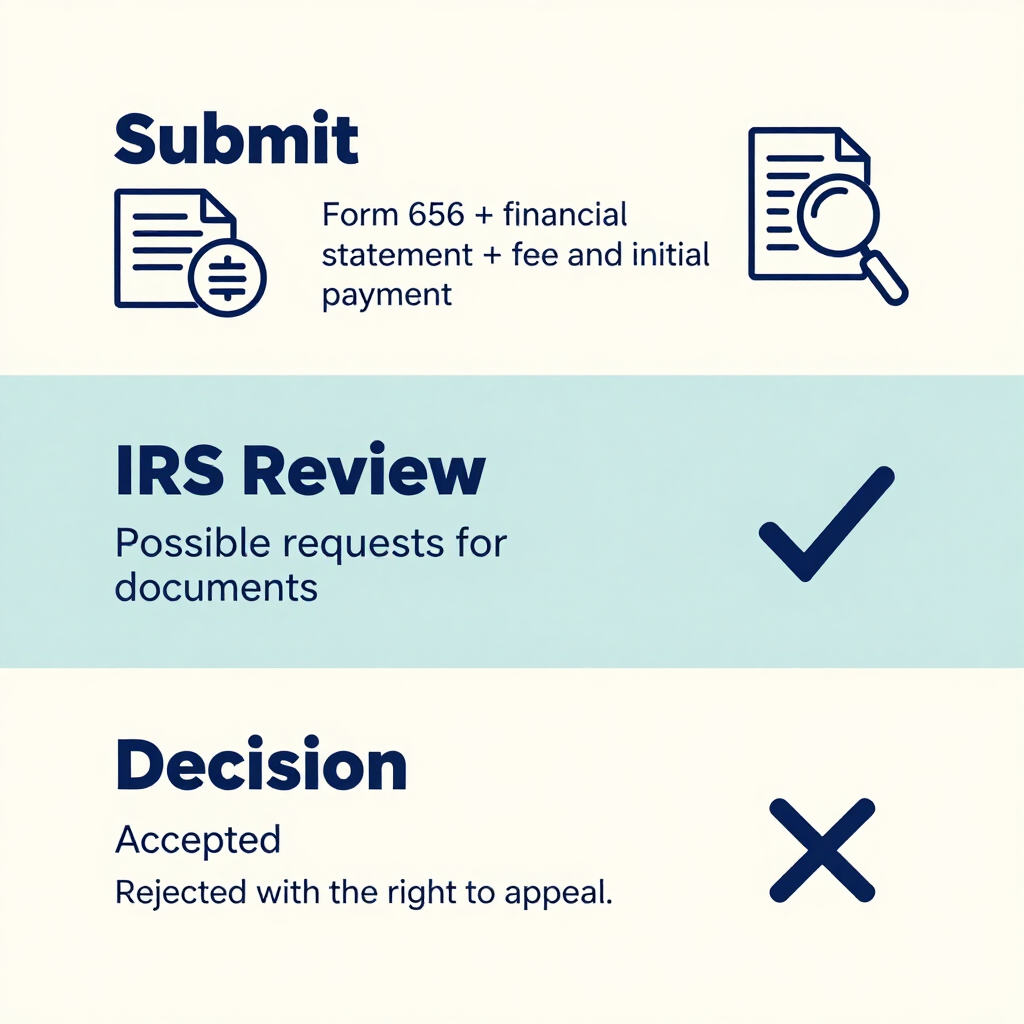
Applying involves several required pieces:
- Form 656, the Offer in Compromise form itself, which states the amount you are offering and the ground you are relying on.
- Form 433-A (individuals) or Form 433-B (businesses), the financial statements that disclose income, expenses, assets, and liabilities.
- A non-refundable application fee and an initial payment, which accompany the submission.
After you submit, the IRS reviews your documentation and may ask for additional records or clarification. Decisions typically take six to twelve months, depending on how complete and consistent your paperwork is.
Offers can be structured around a
lump-sum payment or
short-term periodic payments. The structure changes how much must be paid upfront and how quickly the balance is settled, so it is worth choosing deliberately rather than by default.
What Happens While the IRS Reviews Your Offer
Once a properly submitted offer is under consideration, collection activity is generally paused. The collection statute of limitations is also tolled, meaning the clock that limits how long the IRS can collect stops running during the review.
In return, you must stay current. That means filing every required return and making all required payments, including estimated tax payments for the current year. Falling behind during review is one of the most common ways an offer fails.
Acceptance, Rejection, and Appeals
When the IRS accepts an offer, you pay the agreed amount under the offer's terms, and the remaining balance covered by the offer is forgiven. Acceptance also starts a five-year compliance period: you must file and pay on time, or the IRS can default the agreement and reinstate the original debt.
If the IRS rejects an offer, you have the right to appeal through the IRS Office of Appeals. Common reasons for rejection include:
- Incomplete or inaccurate forms
- An offer amount below the calculated RCP
- Not being current on filings or estimated tax payments
Some of these problems can be corrected, which is why a rejection is not always the end of the road.
An appeal must be filed within the window the IRS gives in its rejection letter. Missing that window can close off the option, so reading the notice carefully and acting promptly is important.
What an Offer in Compromise Does Not Do
- It does not eliminate future tax obligations. You still must file and pay on time going forward.
- It does not apply the same way to every tax type. Trust fund recovery penalties, which are tied to payroll taxes withheld from employees' pay, follow their own specific rules.
- It does not guarantee acceptance. The IRS is selective, and many offers are not approved.
How an Offer in Compromise Fits Into Broader Tax Needs
An Offer in Compromise is one tool among several for resolving tax debt, and it often depends on other work being done first, such as filing missing returns or correcting prior-year records.
An offer rarely stands alone. Most real cases involve several overlapping tax issues, and the order in which they are handled affects the outcome.

Unfiled returns are the most common example. Because the IRS requires filing compliance before it will consider an offer, missing returns generally need to be prepared first.
Payment plans are the alternative when an offer is not the right fit, and the natural fallback if one is rejected. They resolve the debt in full over time rather than settling it for less.
Other related matters can also shape the picture:
- IRS notices and audits. A balance may stem from an examination, and responding properly to notices can affect how much is owed in the first place.
- Penalty relief. Reducing penalties can change the size of a debt before any settlement is discussed.
- Bookkeeping and tax planning. Accurate records support the financial statements an offer requires, and sound planning keeps new balances from forming.
Seeing these connections helps you treat an Offer in Compromise as one part of a larger resolution strategy, not a single form to fill out.
Business owners should pay particular attention to payroll taxes. Unpaid payroll obligations can carry personal exposure for the people responsible for them, and they are handled differently from ordinary income tax balances. Sorting this out early shapes which resolution options are realistic.
The practical takeaway is that the right answer depends on the whole picture. A balance that looks like an Offer in Compromise case on the surface may turn out to be better served by a payment plan, a correction, or a dispute, and the reverse can be true as well.
Accuracy, Documentation, and the Role of Professional Representation
Offers succeed or fail on accuracy. An Enrolled Agent, CPA, or tax attorney helps prepare complete documentation, calculate Reasonable Collection Potential correctly, and communicate with the IRS on your behalf.
An Enrolled Agent is a federally licensed tax professional authorized to represent taxpayers before the IRS. CPAs and tax attorneys can also represent clients in these matters, and each brings a slightly different background.
Representation matters in an offer because the process rewards precision. Three areas tend to decide results:
- Documentation. Financial statements must be complete, consistent, and supported by records. Gaps and contradictions invite delays or rejection.
- RCP calculation. Small errors in valuing assets or applying allowable expenses can move the offer amount enough to change the outcome.
- Communication. When the IRS has questions, timely and accurate responses keep the review moving.
At RQ Tax Resolution, the approach is to explain the process plainly, prepare documentation carefully, and set realistic expectations from the start. An offer is never guaranteed, and a dependable professional will tell you honestly whether it looks like a reasonable path.
Consistency matters as much as expertise. Offers carry ongoing obligations, and clear guidance helps you stay compliant long after the paperwork is submitted.
It also helps to have someone check the numbers against how the IRS actually calculates them. Taxpayers often overstate or understate what they can pay because personal budgeting and IRS standards do not line up neatly.
Reliable guidance includes honest limits. Some taxpayers do not qualify, and knowing that early can save months of waiting, the application fee, and the stress of a rejection that could have been anticipated.
Frequently Asked Questions
Who is eligible for an offer in compromise?
Eligibility generally depends on one of three grounds: you cannot pay the full debt within the collection period, you dispute the debt itself, or full payment would create serious hardship. You must also be current on required filings and payments.
How long does an offer in compromise take?
Most decisions take roughly six to twelve months, though complex cases can run longer. Timing depends on how complete your paperwork is and how much the IRS needs to verify.
Will the IRS stop collecting while my offer is under review?
Collection activity is generally paused while a properly submitted offer is under consideration, and the collection statute of limitations is paused as well. You still need to stay current on filings and payments throughout.
What forms do I need to apply for an offer in compromise?
Individuals submit Form 656 with Form 433-A, while businesses submit Form 656 with Form 433-B. A non-refundable application fee and an initial payment accompany the submission.
What happens if my offer in compromise is rejected?
You can appeal through the IRS Office of Appeals. Many rejections come from incomplete forms, an offer below the calculated RCP, or missed filings, and some of those issues can be corrected.
What happens if I miss a filing after my offer is accepted?
An accepted offer carries a five-year compliance period. Failing to file or pay on time during that window can lead the IRS to default the agreement and reinstate the original debt.
Is an offer in compromise the same as a payment plan?
No. A payment plan lets you pay the full balance over time, while an offer settles the debt for less than what you owe.

Get Started Today
If you’d like to talk through your situation, our team at RQ Tax Resolution is glad to answer your questions and help you understand where you stand. You can schedule a no-pressure call at a time that works for you, or use the form on this page.