
Unfiled Tax Returns:
A Practical Path Back to Compliance for Taxpayers
Who This Service Is Typically For
- Individuals with IRS balances or notices
- Small Business Owners
- Taxpayers Behind on Filing or Payments
If questions come up as you read, additional guidance is available when needed.
Ask a Tax Resolution Specialist:
We will get back to you as soon as possible.
Please try again later.
Unfiled Tax Returns:
How to Catch Up and Get Compliant

Unfiled tax returns are returns that were due to the IRS but were never submitted. Falling behind on filing is more common than most people realize, and it can happen to anyone, from a busy business owner to someone working through a difficult stretch of life.
The situation is usually fixable. Filing the missing returns is the first step toward stopping penalty growth, replacing IRS estimates with accurate numbers, and building a plan for any balance.
This page explains what unfiled returns can lead to, how catching up works, and what happens afterward. The information is general, since every case depends on the years involved and the records available.
Why Unfiled Tax Returns Get Harder to Fix the Longer They Wait
Unfiled returns become more costly over time because penalties and interest keep building, and the IRS can file a substitute return that ignores your deductions. Collection actions may follow.
Filing and Paying Are Two Separate Obligations
Many people assume they cannot file because they cannot pay. In reality, filing (submitting the return) and paying (sending the tax owed) are separate obligations, and each carries its own consequences.
A filed return with a balance gives you something to work with. An unfiled return gives you only risk, because nothing can be resolved until the return exists.
Why People Fall Behind
Nobody sets out to leave returns unfiled. The reasons are usually human:
- Inability to pay what is owed, paired with the belief that a return must be filed with payment
- Lost records or incomplete documentation
- Life events such as illness, divorce, or a business that closed
- Fear of consequences, which typically makes things worse, because the problem grows while it is avoided
Each of these is understandable, and several of them feed one another. Fear leads to avoidance, avoidance leads to missing paperwork, and missing paperwork makes the next return feel even harder to start.
What Unfiled Returns Cost
The IRS applies several charges when returns go unfiled:
- Failure-to-File penalty. Generally 5% of the unpaid tax for each month the return is late, up to a maximum of 25%.
- Failure-to-Pay penalty. Generally 0.5% of the unpaid tax per month.
- Interest. Accrues on both the unpaid tax and the penalties themselves.
Because interest compounds, the total grows faster than most people expect. A balance that seemed manageable in the first year can look very different a few years later.
The Failure-to-File penalty is much larger than the Failure-to-Pay penalty, which is one reason filing matters even when full payment is not possible right away.
The IRS may also prepare a Substitute for Return (SFR), a return it files on your behalf using the income information it has on record. An SFR typically produces a higher tax bill, because it does not claim the deductions, credits, or filing status benefits you may be entitled to.
How Collection Actions Escalate
Once a balance is assessed, the IRS usually sends a series of notices that grow firmer over time, such as CP503, CP504, and LT11. They move from reminders toward a formal notice of intent to levy, and each one has response deadlines.
If a balance stays unresolved, the IRS may take collection actions, including:
- Federal tax lien. A public record attached to your assets that can complicate selling or borrowing against property.
- Wage garnishment. A levy on wages, where a portion of each paycheck goes to the IRS.
- Bank levy. A seizure of funds from your bank account.
- Asset seizure. Reserved for extreme cases.
These steps are escalations, not the starting point. Acting before they begin leaves more options on the table.
Why the Statute of Limitations Works Against You
Time limits normally protect taxpayers, but unfiled returns change how they apply:
- The three-year window to claim a refund applies only if the return is actually filed. Leaving a return unfiled can forfeit money you were owed.
- The ten-year collection statute, the limited period the IRS has to collect a tax debt, does not begin until the IRS assesses the tax. Assessment requires a filed return or a substitute return.
In practical terms, unfiled returns can leave you exposed with no clock running in your favor. Filing is what allows the protective time limits to start.

What Does Catching Up on Unfiled Tax Returns Involve?
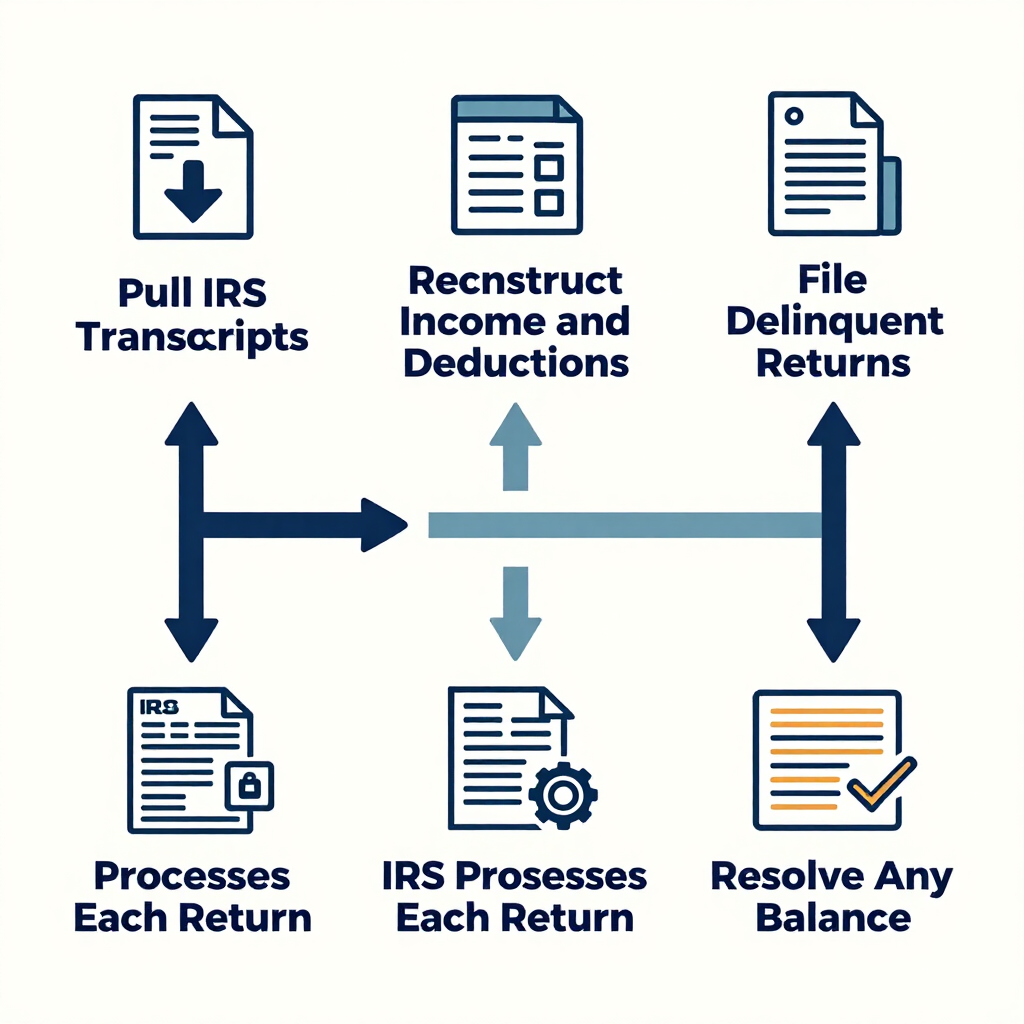
Catching up involves learning what the IRS already has, reconstructing missing records, filing every delinquent return, and planning for any balance that results. It is a structured process, not a single form.
Starting With IRS Transcripts
The first step is understanding what the IRS has on file.
IRS transcripts are official summaries of the income reported to the IRS under your name, such as wages and 1099 income, along with account activity.
Transcripts show what third parties reported, which tells you what the IRS expects to see and where records may still be missing.
Different transcripts show different things. One summarizes the income reported by employers and payers, while another shows the balances, penalties, and notices already recorded on your account. Together they give a realistic starting picture.
Reconstructing Missing Records
Lost records are one of the most common obstacles, and they are rarely a dead end. Income and expenses can often be reconstructed from:
- Bank statements showing deposits and payments
- Forms 1099 and W-2 issued by payers
- IRS transcripts showing third-party reporting
- Other records, such as invoices, receipts, and account histories
The goal is a return that is reasonable, supportable, and honest about what can and cannot be documented.
How Many Years Need to Be Filed
The IRS generally expects compliance for the most recent six years. That does not mean older unfiled years are ignored, and some situations call for different handling, so the right scope depends on your history and any IRS contact.
Business owners may have more than personal returns to consider. Business, payroll, or entity returns can also be unfiled, and each type has its own forms and rules, so a full inventory of what is missing comes before any filing begins.
Filing Late Returns
Each tax year is filed on its own return, using the forms that applied to that year. Returns should include all reported income, along with the deductions and credits you can support.
Any tax owed is reported on the return itself, and payment can be arranged separately. Filing does not require paying in full on the same day.
If the IRS has already filed a substitute return for a year, submitting your own accurate return may allow the figures to be corrected. That review depends on the facts, but it is one of the main reasons filing yourself often leads to a better result than waiting.
Voluntary vs. IRS-Initiated Compliance
Catching up on your own initiative is called voluntary compliance. The alternative is IRS-initiated compliance, where the IRS contacts you, prepares a substitute return, or begins collection.
Voluntary filing generally gives you more control. You decide which supportable deductions to claim, how records are presented, and how a balance is handled, rather than reacting to IRS estimates.
What Happens After Filing
Once filed, the IRS processes each return and issues either a refund or a balance due. Refunds from late returns are possible, but only within the allowed time window.
If a balance is owed, several resolution options exist:
- Installment Agreement, a payment plan that spreads the balance over time
- Offer in Compromise, a program that may settle the debt for less than the full amount for qualifying taxpayers
- Currently Not Collectible status, a hold on collection when paying would prevent meeting basic living expenses
Penalties on late returns may also be reduced through penalty abatement. First-time abatement can apply to taxpayers with a clean compliance history, and reasonable cause can apply when circumstances such as serious illness prevented filing. Neither is automatic, and eligibility depends on the facts.
Criminal Exposure: When It Applies and When It Does Not
This is the fear that keeps many people from filing, so it deserves a direct answer. Most unfiled returns are a civil matter, handled through penalties, interest, and collection rather than prosecution.
Criminal prosecution for tax evasion requires willful intent, meaning a deliberate effort to evade tax. It is rare for individuals who come forward voluntarily. Voluntary disclosure and good-faith compliance meaningfully reduce risk, although no outcome can be guaranteed.
If a case involves unusual facts that raise concern, consulting a tax attorney is a sensible step.
What This Service Includes
Catching up on unfiled returns typically includes four parts:
- Pulling IRS transcripts to see what the IRS has on file
- Reconstructing income and deductions from available records
- Preparing and filing all delinquent returns
- Developing a resolution plan for any resulting balance
How Filing Back Returns Connects to Your Wider Tax Needs
Catching up on unfiled returns often leads into related work, such as resolving a balance, improving bookkeeping, and planning to stay current. Each piece supports the next.
Filing is usually the start of the solution, not the whole of it. Once returns are on file, any balance can be addressed through a payment plan, a settlement program, or a hold on collection.
Bookkeeping is the foundation for staying current. Many people fall behind because records were scattered or incomplete, and organized books make every later filing simpler.
Tax planning helps prevent a repeat. Estimated payments, withholding adjustments, and setting money aside for tax can keep new balances from forming.
Staying current also matters for what comes next. Many resolution options require that all required returns be filed and current-year obligations met, so catching up is often the doorway to those programs.

If the IRS has already begun reviewing any year, audit representation may be needed alongside the filing work. For business owners, unfiled payroll or entity returns add another layer, and addressing them together keeps the picture consistent.
Seeing these connections keeps the task manageable. You are not solving every problem at once; you are working through them in a sensible order.
Accuracy, Discretion, and Steady Guidance
Catching up works best with accurate numbers, careful documentation, and clear communication. A steady process matters because several years of returns, records, and decisions are involved.
Accuracy matters even more when records are incomplete. Reconstructed figures need to be reasonable and supportable, because the IRS compares returns against the third-party reporting it already holds.
Three practices guide the work:
- Accuracy. Figures are checked against transcripts and source records.
- Completeness. Every required year is accounted for, so nothing is left behind.
- Clarity. You understand each return before it is filed and know what to expect afterward.
At RQ Tax Resolution, the approach is to explain each step plainly, work without judgment, and move at a pace that keeps the process steady rather than overwhelming.
Judgment-free guidance matters here. Many people carry shame about unfiled returns, but the situation is common, and a clear plan is far more useful than regret.
Clear communication includes setting expectations about timing. Gathering records, preparing several years of returns, and waiting for IRS processing all take time, and knowing that in advance prevents unwelcome surprises.
Honest guidance also means realistic expectations. Some balances can be reduced and some cannot, and understanding which is which helps you make sound decisions.
Frequently Asked Questions
What happens if I haven't filed taxes in years?
Penalties and interest keep growing, and the IRS may file a substitute return that overstates what you owe. Filing the missing returns stops that cycle and lets you address any balance directly.
How many years of unfiled tax returns do I need to file?
The IRS generally expects the most recent six years. The right number depends on your history and any contact from the IRS.
Can I file back taxes if I can't afford to pay?
Yes. Filing and paying are separate obligations, and filing limits the penalty that grows fastest. Payment plans and other options exist for balances you cannot pay in full.
Will I go to jail for not filing my tax returns?
In most cases, no. Most unfiled returns are civil matters, and prosecution requires willful intent and is rare for people who come forward voluntarily.
What if I've lost my tax records?
Income and expenses can often be reconstructed from bank statements, 1099s, W-2s, and IRS transcripts. Missing paperwork is common and rarely prevents catching up.
How long does it take to catch up on unfiled returns?
It depends on the number of years and how complete your records are. Gathering records and transcripts usually takes the longest, and the IRS processes each return separately afterward.
What is a substitute for return (SFR)?
It is a return the IRS prepares for you using reported income when you have not filed. It typically leaves out deductions and credits, so the resulting tax bill is often higher than one you would file yourself.

Get Started Today
If unfiled returns have been weighing on you and you’re unsure where to begin, contact RQ Tax Resolution and speak with an expert who can help you take stock.
You can call (619) 937-3322, or clik button below to connect with usl.
A straightforward conversation about your situation is a practical place to start, at your own pace.